Designing a strong AV product is only the start. Inavate explores with Axion Displays how positioning, local expertise, and support can determine whether technology ever gains real traction.
There is no shortage of engineering talent in professional AV. New display technologies, processing platforms, and software products arrive constantly, often backed by impressive specifications and considerable R&D. Yet technical capability alone is no guarantee that a product will find its place in the market.
For Dirk Siedle, general manager and head of sales at Axion Displays, that disconnect between what can be built and what customers actually need was one of the reasons for creating the company.
After 13 years working within large corporate organisations, Siedle saw first-hand how easily manufacturers can become focused on products rather than applications. “A lot of people are too inward looking,” he says. “They look at what’s technically possible, instead of looking at what the market is asking for.”
A manufacturer may have a highly capable technology, but to turn that into business it still needs the right positioning, the right route to market, and people who understand how the product fits into real projects.
That is where Axion is attempting to carve out a different role. Rather than presenting itself as a conventional distributor, the company sits between manufacturers and the channel, combining elements of a local manufacturer presence with the freedom to build solutions from more than one technology platform.
“The challenge you have with being a manufacturer is you’re offering a very small part of what integrators and end users actually need,” says Siedle. The result, he argues, is that the channel is often left trying to assemble a complete solution from multiple sources.
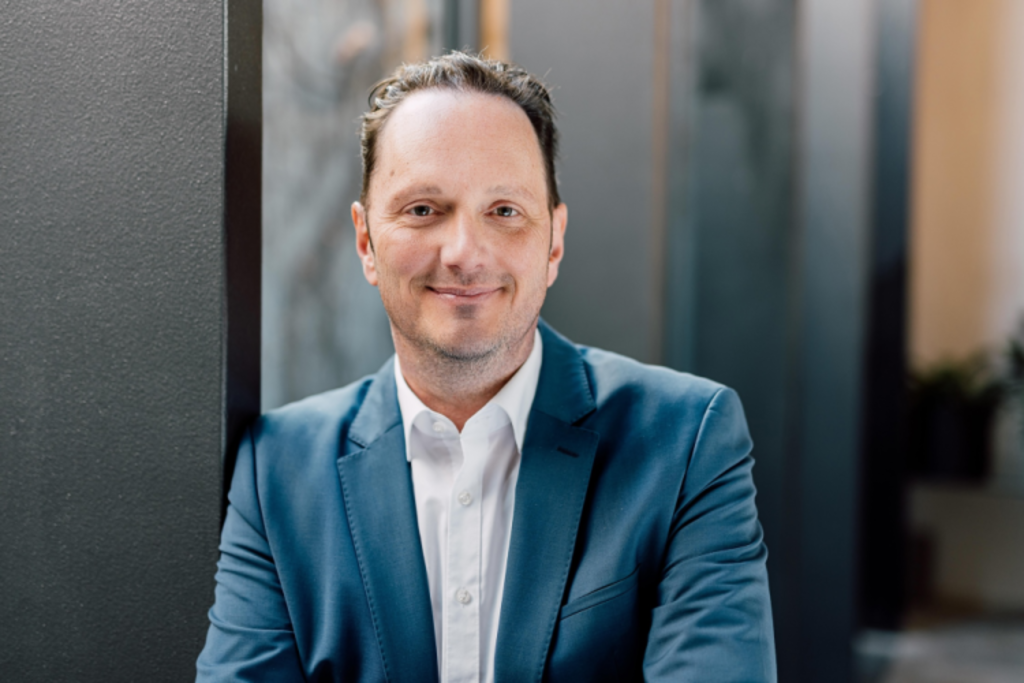
Dirk Siedle, general manager and head of sales at Axion Displays
Axion’s starting point is large-format images. Its portfolio brings together projection, LED, and media processing technologies, with Digital Projection, Magnos, and Brainsalt among the brands represented. Axion is also developing its own software and is prepared, Siedle says, to create or source additional components where a project exposes a gap.
The point is not simply to assemble a longer product list. Siedle argues that the value lies in understanding what an end user is trying to achieve and then working backwards to the most appropriate combination of technologies.
He points to the projector market as an example of where specification-led selling can miss the wider requirement. For years, much of the conversation revolved around more lumens, lighter chassis, and ever-higher performance figures. But an attraction, immersive venue, or specialist installation is rarely conceived around a brightness number.
“It’s not about brightness or certain contrast levels,” he says. “It’s about which product does the job.”
That shift from product specification to problem solving sits at the centre of Axion’s pitch to systems integrators. Siedle believes channel partners are under growing pressure, not only in terms of time but also in the breadth of knowledge required to deliver increasingly complex projects.
Manufacturers can provide deep expertise in their own technologies, while traditional distribution can provide access to a wide catalogue. Axion is trying to occupy the space between those models: representing selected manufacturers locally, but with enough independence to recommend something else if another technology is better suited to the job.
“Axion is like a reality check,” says Siedle. The company can look at a manufacturer’s portfolio, identify where it adds value, and combine it with products from elsewhere when the application demands it.
That approach also depends heavily on local knowledge. Professional AV may be an international industry, but expectations around support, service, and business relationships can change markedly between territories. Siedle gives the example of Germany, France, and the Middle East: different markets within a global supply chain, but with very different customer expectations.
“You need to have local people dealing with local customers and you need to be able to respond to local requirements,” he says.
For a relatively new name, those relationships are particularly important. Axion may be a young company, but much of its team comes with established experience, contacts, and product knowledge. Siedle sees personal service as one of the ways it can translate that history into trust in the new business.
“Trust comes from being reliable, being there when the customer needs us, solving problems when problems come up,” he says. That also means customers reaching people who know the project and the technology rather than being passed into an anonymous support structure.
This emphasis on support is important because good products can fail for reasons that have little to do with engineering. Siedle identifies two fundamental tests. First, the technology has to solve a genuine problem for the integrator or end user. Second, the route to market has to work.
A product can have strong specifications, an attractive price and good availability, but if the chain between developer and end user introduces friction rather than value, adoption becomes much harder. Equally, a technically impressive product that duplicates existing functionality without addressing a real need may struggle to justify itself.
“It needs to solve a problem for the channel or for the end user, that’s number one,” says Siedle.
That philosophy can take Axion beyond the boundaries of the products shown on its website. Siedle describes a recent application in which a customer needed a specialist terminal combining a display, physical hardware, and links into its own software. Axion sourced and configured a solution in days, rather than trying to force the requirement into an existing catalogue.
Siedle says this is the clearest expression of what the business is intended to do: “At the end of the day, we live from selling technology, but we sell by fixing problems for the channel.”
It is also a useful reminder for the wider AV industry. Product development remains vital, but innovation does not stop when something leaves the factory. Understanding where it fits, who needs it, how it should be positioned, and what support sits behind it can be just as important as the engineering itself.
Top image: Axion Displays represents Digital Projection, whose high-performance projection technology is used for professional AV, themed attractions, and immersive experiences | ©Marius Sumlea