As 4K becomes part of everyday professional video, the challenge is shifting from whether it can be done to how it can be delivered without the cost, complexity, and specialist knowledge once associated with high-resolution production.
There was a time when 4K sat firmly at the premium end of professional video. Today, the picture is different. Displays are improving, content is being captured at higher resolutions as a matter of course, and audiences are increasingly accustomed to sharp, high-quality images in every part of their lives.
Nico Suarez, Pro AV product specialist at Roland says one of the clearest drivers is the development of LED itself: “As pixel pitches get finer, LED walls can accommodate more pixels in the same physical space, and that is driving the need for higher-resolution content.”
The result is that 4K is no longer confined to large broadcast environments. As its use spreads, the challenge is making it practical for a much broader range of users and applications. Dan Taman, European product manager at Roland, says: “We’re not just doing 4K for the sake of it, we’re trying to make it more accessible. It’s not a specialty requirement; it is something that’s become mainstream.”
That change creates a new engineering challenge. In many cases the issue is not simply generating a 4K signal, but dealing with mixed sources, different formats, and displays that bear little resemblance to a conventional 16:9 canvas.
System integrators, rental companies, and in-house AV teams are increasingly requiring that flexibility across a widening range of applications. Rather than being tied to a particular application, the requirement follows the LED. As LED walls become commonplace across corporate, education, worship, auditoriums, retail, studios, and live events, so too does the need for tools that can manage high-resolution content and non-standard display formats.
“Video is becoming more and more synonymous with everything,” Taman says. “Most of us now have 4K high-quality cameras in our pockets. If people are recording at that quality and they want the absolute best quality for what they’re doing, the next question is: how do I mix these video signals?”
Roland’s V-1-4K is aimed at simplifying the production side of that equation. The compact switcher provides five HDMI 2.0 inputs, scalers on every input, 4K USB-C streaming, integrated audio mixing, and PTZ camera control, while remote operation is available through dedicated control applications. It can also accommodate mixed HD and 4K sources, reducing the need for separate conversion before signals reach the switcher.
Taman believes that this continues a philosophy that has long been associated with Roland’s V-1 range. “The V-1 has a bit of a legacy for introducing people into video mixing,” he says. “I think the V-1-4K continues that legacy in being an easily approachable unit. What we’re trying to do is make 4K practical; not just technically possible, but something that’s actually achievable.”
One feature that illustrates that approach is Region of Interest (ROI) mode. The V-1-4K can crop up to four separate shots from a single 4K camera source, allowing an operator to create different views without adding cameras. In a meeting, lecture, panel discussion, or studio environment, for example, a single wide camera can be used to create multiple framed shots, helping reduce both hardware requirements and production complexity.
Ease of operation is an important part of the proposition. Suarez argues that users already familiar with AV should be able to understand the system quickly rather than needing extensive product-specific training. “These are complex technologies, but we try to present the interface as simply as possible for anyone in the AV industry,” he says.
But simplifying production is only part of the 4K challenge. Once content leaves the switcher, it still has to be adapted to an increasingly diverse display landscape. That is where Roland’s VC-1SC-4K converter/scaler comes in. At its most basic it converts between SDI and HDMI, but its capabilities go considerably further. Flexible scaling, ROI cropping, and size and position controls allow standard video content to be adapted for LED walls with unconventional resolutions and aspect ratios.
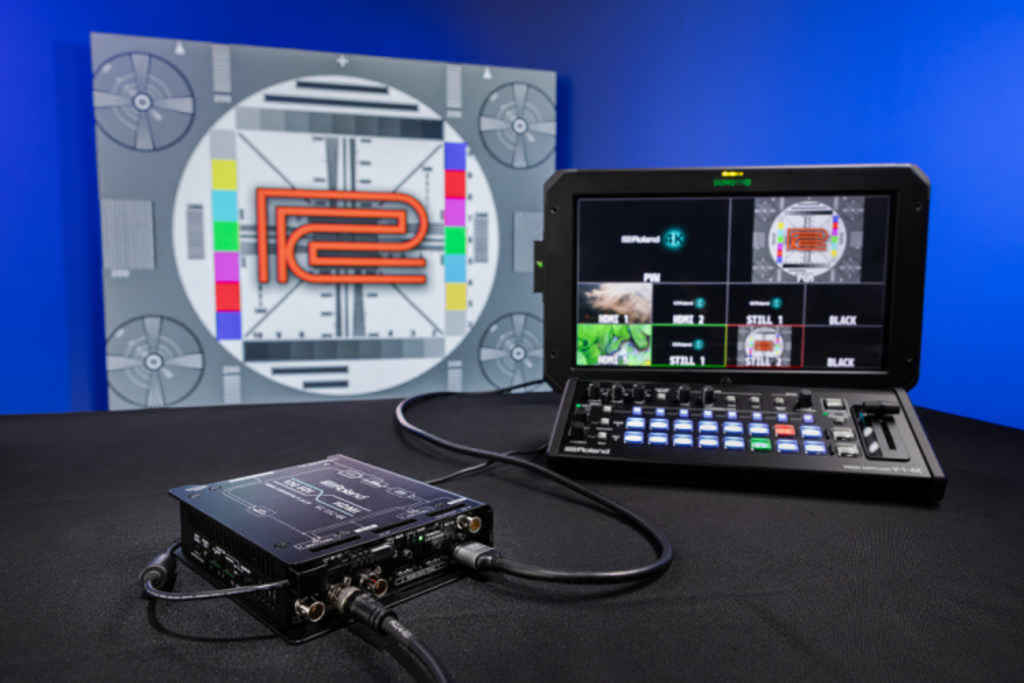
Suarez describes the problem as the difference between standard video formats and the modular, “Lego-style” nature of LED. A display can be built to fit a physical space rather than a predefined video standard, which means content created at 16:9 does not necessarily map neatly onto the final canvas.
“This is where the VC-1SC-4K plays a part,” he says. “It lets you take a portion, spread it, squeeze it, or make a pillar box or letter box. It helps you adapt those fixed standard aspect ratios into the design you have created.”
That flexibility extends beyond the video signal. Suarez calls the VC-1SC-4K a “Swiss Army knife”: one day it may simply convert SDI to HDMI; another it may need to change frame rate, reshape content or perform several tasks within the same signal path. Audio is treated as an equally important part of that workflow, with balanced XLR I/O for embedding and de-embedding, audio monitoring through VU meters in the control app, as well as patching and delay capabilities.
The VC-1SC-4K has also been designed for environments where reliability matters. Its rugged metal chassis and physical construction reflect Roland’s experience in demanding live production applications, where low latency is equally critical. Suarez points to two-frame latency alongside hardware details such as connectors that are screwed to the chassis rather than relying solely on the PCB connection, helping them withstand repeated connection and disconnection. Equipment engineered to cope with repeated setup, handling, and the pressures of live operation can bring the same resilience to fixed installations and everyday corporate or education use.
Together, the two products represent Roland’s answer to a market in which 4K capability is spreading while users simultaneously expect systems to become easier to operate.
And the expectation is not only from technical teams. Taman suggests audiences themselves increasingly recognise when content does not match the quality they experience elsewhere. “People can tell when they’re looking at something that isn’t high resolution,” he says. “Even subconsciously, that can make the production feel less professional, and that reflects on the organisation presenting it.”
It’s an important consideration for organisations using video to communicate, teach, present, or engage an audience. As 4K moves from specialist territory into the everyday AV toolkit, the differentiator increasingly isn’t access to the technology alone, but how easily and reliably it can be put to work.
Find out more about Roland’s 4K video solutions