A new experience in London combines a live piano recital with a VR world you can roam around inside. Paul Milligan speaks to two of the companies involved.
For a four-month run (Sept 2026 to Jan 2027) London’s Southbank Centre is home to Playing With Fire: An Immersive Odyssey with Yuja Wang. Held at the Royal Festival Hall, it’s part of the venue’s 75th anniversary celebrations, and the production marks a significant mixed-reality project at one of the UK’s leading cultural venues.
The writer and director of Playing With Fire is Pierre-Alain Giraud, whose work expands the traditional piano recital format through a combination of live performance language, recorded volumetric capture, virtual reality, mixed reality, visual art, and spatial audio. The production has been developed by Vive Arts (a subsidiary of tech company HTC) and immersive entertainment provider Atlas V, and is a virtual concert featuring a pre-recorded avatar of international pianist Yuja Wang, captured at a Steinway Spirio (automatic) piano using volumetric technology. The creative team also includes visual designer Gabríela Friðriksdóttir and spatial audio designer Nicolas Becker.
Audience members wear Vive Focus Vision VR headsets and are able to move around the performance space, viewing Wang’s playing from angles that would not be possible in a normal concert hall setting. The experience shifts between mixed reality and virtual reality according to the participant’s position in relation to the piano, creating a layered encounter with both the musician and the surrounding visual environment.
We spoke with Antoine Cayrol, co-founder and CEO of Atlas V and Samantha King, director of programme at Vive Arts to find out more. The genesis of Playing with Fire, says King, came from an initial collaboration with Lightroom,
an immersive venue in London; Steinway; and Yuja Wang to create a new mixed reality installation that would feature Wang at its centre. Vive Arts had worked with Atlas V on previous projects and collaborated with the company again on this one.
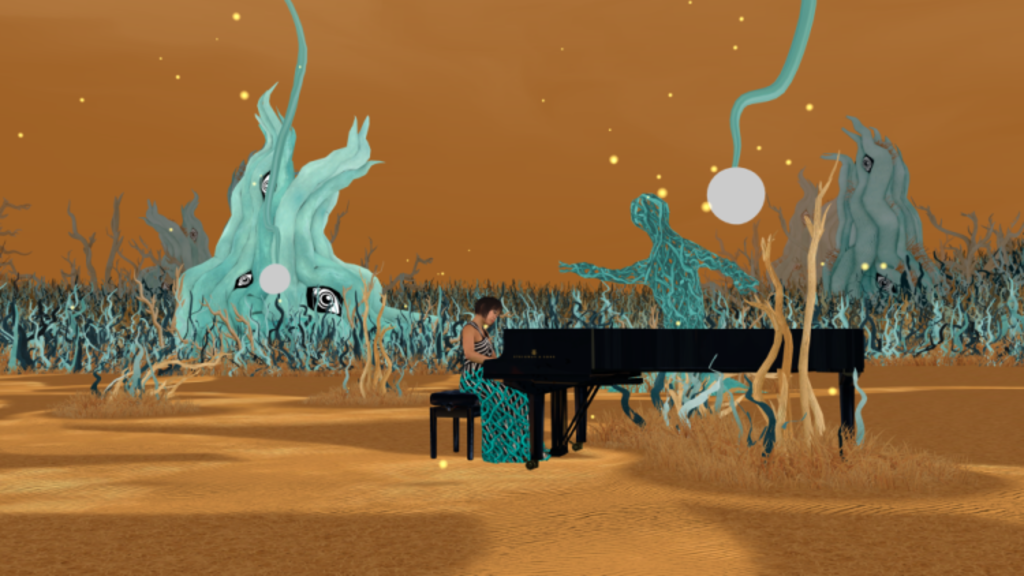
Playing With Fire begins with a gentle introduction to the space, before audience members put on their headsets. A tutorial guides the audience through how they will interact with the world as it unfolds around them. The show begins with Yuja appearing as a volumetric avatar, entering the space, sitting down and beginning to perform Ravel’s Jeux d’eau. A water scene begins and then the water level rises and rises until the audience is submerged in virtual reality, and they are invited to wander through the space. “It’s really lovely seeing how people interact,” says King. “A lot of people begin holding hands together and exploring the space.”
When we think of classical music performances, the image is probably one of a staid, conservative, seated crowd, watching a performer on stage. What does having the ability to walk around the space bring to a classical music performance such as this? “I fundamentally believe that virtual reality is really significant in bringing emotional resonance and presence to the story,” says King. “The viewer has to be active. Our idea was to create a new form of classical recital, a new form of performance where the audience member can have an unprecedented intimacy and closeness to the performer. We use this medium and the oscillation between mixed reality and virtual reality to pivot between these two perspectives. You can come very close to the piano, you can see the physical piano in mixed reality, and then you see Yuja’s volumetric avatar synced to the piano. There isan interplay between two worlds.”
To further delight the audience, Cayrol has hidden easter eggs theaudience will only unlock by walking around the room. The production uses visual and audiodesign to reflect shifts in mood, tone, and musical character, and the animations from Friðriksdóttir blend in sync with audio.
Despite being vastly experienced in volumetric capture, this project brought with it a new challenge for Atlas V says Cayrol. “Usually the capture part is okay, but when you need to record somebody playing faster than the speed of the light, it’s a challenge. If you watch herplay on YouTube, it’s hard to see her fingers, so doing that in volumetric capture was a huge challenge.” One idea was to put gloves on her hands and track the movement of her fingers that way, but Yuja declined, concerned that they would impede her performance. What followed, says Cayrol, was two months of R&D to get the timing exactly right.
With a room full of people wandering around with VR headsets on, listening intently to music, how do you stop collisions? “If they see a blue wall [in the headset] it means you’re going to bump into a physical barrier or a wall,” explains King. The audience can see each other in the space via avatars that only become visible when they are within a certain proximity to that person. “You’re not seeing everyone in the space, so it doesn’t feel overbearing, but you still have the feeling of presence,” adds King. If you visit in a group, you can even choose a team colour for your avatars, so you can see when someone familiar is close to you.
We don’t naturally think of classical music as being a technologically innovative medium, so could a project such as this help bring the music to a new audience? “I don’t think so, I know so,” says Cayrol. In a previous run in Paris, the audience for the first few weeks was, he adds, largely made up of the traditional classical piano crowd, mostly aged 45-70. “Then it started exploding into a younger audience, they needed to wait for the reviews, word of mouth, for it to appear on TikTok and Instagram. Technology is a huge plus for the young generation.”
One of the really interesting aspects of this project is the cross-pollination potential with audiences says King. “Some people will be coming for the music or to see Yuja, because she’s an amazing world-acclaimed pianist. But she’sonly one physical person that can be in one place at a time. There’s also a world in which she’s able to travel through this experience and perform in places that maybe she wouldn’t be able to usually, or people would be able to access her performance in a different way. But then you’ll have people that will come because it’s an immersive installation. This is something we’re really interested in, to open up a gateway for them to engage more with classical music,” says King.
VR can bring in a new audience, but what about the existing audience? For those familiar with classical music, can technologies such as VR help audiences hear works that may be hundreds of years old, and that they may have heard many times before, in a new way? “A lot of people in the crowd are used to going to this kind of piano concert but were keen for something new,” says Cayrol, who sat in on a few shows in Paris as an audience member to watch the different crowd reactions. “People were clapping at the end of everysong, even though she [Yuja Wang] is not there, for them it’s a real show.”
The music may be centuries old, but Playing With Fire is bringing something new to audiences says King: “You’re seeing it with a visual landscape with beautiful surrealistic visions around it. It’s a completely new way of opening up how to imagine this music and bring it to life.”
One criticism of VR-led experiences has been they can often be solitary so does having a headset during Playing With Fire reduce the communal feeling of being at a music concert? King says this was very much on the team’s minds when developing and resigning Playing with Fire, because it is a location-based experience: “You are going somewhere to do this, it’s an experience in itself, it’s very different to being at home on your own and experiencing something just in a headset.”
It has been specifically designed as a collective experience adds King: “You see each other, you see people walking around you, or you see these avatars that are part of the environment. We really want to be very deliberate in the design of it as an installation, to have a mix between the physicality and virtual design, and there’s something very magical there.”
The climax of Playing With Fire has been designed to create a collective, shared moment to remember. At the end for the performance of Chopin’s Waltz in A Minor, the audience takes their VR headsets off and there is a period to just bask in the piano performance. A beam of light is shone through the vast space, and people are invited to dance with one another along to the music. “They have this campfire moment where people gather and then leave the gallery. In terms of the experience design, it’s very deliberate, bringing people in and out of it so that they feel connected with each other,” adds King.