Virtual production may have been popularised by high-end film, TV, and advertising work, but Anna Mitchell discovers that some of the most revealing conversations about the future of the technology are now taking place in universities.
As LED-based VP facilities move into education, the assumption might be that universities are building smaller, simplified versions of commercial production stages. The reality is more complicated. In some cases, the technology is comparable. What changes is the brief.
A commercial VP stage is usually designed around efficiency, throughput, and the needs of a specialist production crew. A university facility has to do more: support teaching, research, experimentation, multiple departments, student access, industry collaboration, and, in some cases, professional production work as well.
That makes education a particularly demanding market for LED, processing, tracking, media servers, real-time tools, and systems integration. These spaces must be robust enough to deliver professional-standard results, but open enough for students to test, break, rebuild, and understand the workflows behind them.
For AV integrators and technology suppliers, the education opportunity is not simply about selling LED walls into universities. It is about helping institutions build flexible, future-facing production environments that can train the next generation while also contributing to a field that is still defining itself.
A broader brief
The question of whether a university VP studio differs from a dedicated commercial production stage does not produce a simple answer. For Florian Schlecht, director studios at integrator Econocom ICT, the difference is not necessarily technical.
“In some education projects, the specification can be extremely high because the facility is expected to do more than one thing,” he says. “It may need to support virtual production, motion capture, simulation, training, and research, rather than being optimised only for commercial shoots.”
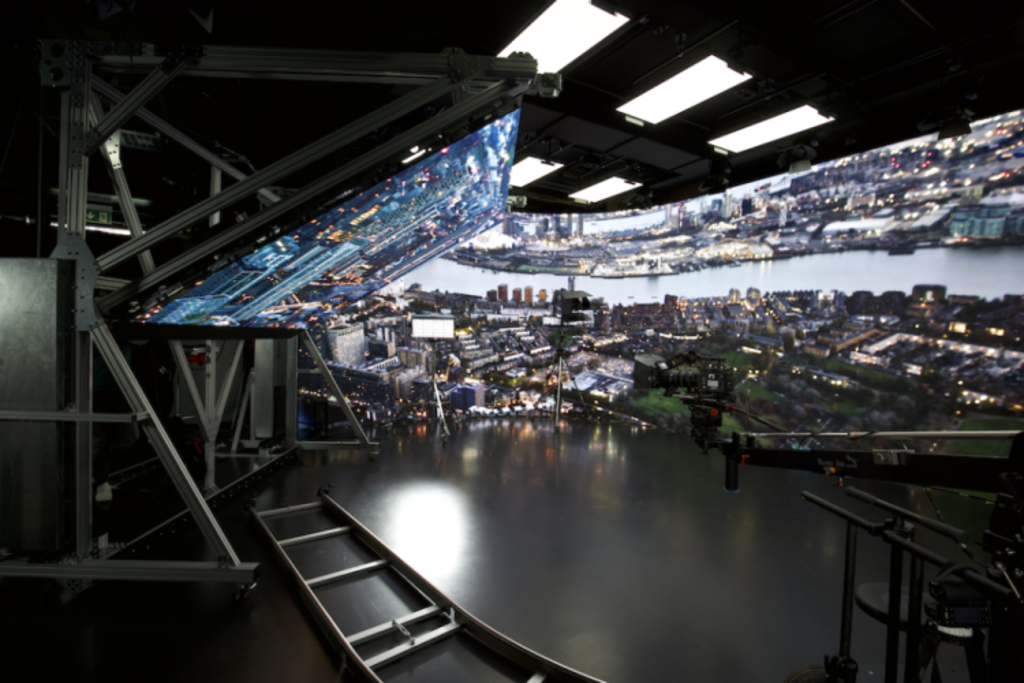
Built by Econocom ICT, Hamm-Lippstadt University’s VFX Lab shows how education VP facilities can support teaching, research, simulation, and media production within a single LED-based environment
In that sense, the education brief can be broader than the commercial one. A commercial stage may be designed around a narrow, repeatable production workflow. A university facility needs to expose students to a range of workflows, tools, and technical approaches, because the point is not simply to complete one production efficiently. It is to teach students how the system works and how to adapt when conditions change.
Schlecht says that can affect how a facility is specified. “You have to blow it up a little bit because you want to teach different systems,” he says. He points to the value of students encountering different cameras, processing platforms, tracking systems, and production tools. “You always have different challenges, and students must learn every situation to handle all possibilities.”
In commercial VP, standardisation and repeatability are often the goal. In education, variability can be part of the teaching value. Students need to understand not just one route through the workflow, but the relationships between cameras, lenses, grip, tracking, LED processing, content, and lighting.
Andrew Amato, creative producer, Disguise, sees the same divide from a workflow perspective. “A commercial facility is built around revenue, deadlines, and throughput,” he says. “A production company books the volume, a crew arrives with a tech scout and pre-viz already (hopefully) locked, they shoot, they strike, and the next job moves in.”
The university model is different. “A university studio has to serve teaching first and production second,” Amato continues. “There is almost always a group of students with a different skill level walking in every few hours, sometimes in every class.” That means a facility has to deal with resets, documentation, staff and student turnover, and multiple disciplines competing for time in the same space.
“It’s less about protecting one workflow and more about building a system flexible enough to survive constant handoffs and purposes,” he says.
The camera is unforgiving
Although the education brief is broader than the LED wall, the wall remains a critical element. Virtual production changes what is required from LED because the final judge is not the human eye, but the camera.
Alistair Mizon, product & technology manager – rental & staging – AbsenLive Europe, says this is where VP departs from more conventional display applications. “The camera sees scanlines the eye never will,” he says. “It notices small artifacts, dropped frames, or desynchronisation, and the slightest colour shift becomes glaringly obvious when you’re staring down the barrel of camera one.”
That reality changes product priorities. In rental and staging, Mizon says cabinet design, deployment speed, durability, and edge protection may sit alongside image quality. In virtual production, those priorities shift. “In a VP product, image quality is paramount, all else becomes secondary,” he says.
That means higher quality driver ICs, stronger scan performance, tighter SMD binning, improved colour accuracy, uniformity, contrast, and reduced reflectivity. It also means integrators and education clients need to think beyond headline pixel pitch. The LED has to work as part of a camera-facing production system, synchronised with processing, real-time engines, tracking, lighting and the chosen camera package.
But education clients are not always buying to the same priorities as a high-end commercial VP stage. Mizon says education budgets are tighter than Hollywood, and the product often needs to serve different courses and use cases. That may make durability, flexibility, and total value just as important as peak image performance.
“Education is becoming a significant area of growth with drivers including more accessible technology on the market, product availability, and more manageable costs,” he adds.
Flexible by design
For education, flexibility is often central to the return on investment.
Mizon says modular LED is becoming increasingly important because “educational institutes need spaces that can support more than one use case, rather than functioning solely as a dedicated VP studio”. These environments may need to accommodate hybrid teaching, practical production work, and technical training, giving students the opportunity to learn how to create content as well as how to build, manage, and maintain the technology behind it.
At universities, a VP facility may be used by film, VFX, animation, games, live events, broadcast, theatre, performance, fashion, immersive media, and research students. It may also support marketing, industry collaboration, and commercial or semi-commercial projects. This creates a far more complex stakeholder environment than a dedicated commercial stage.
Dr Ken Pitts, course leader, Southampton Solent University, says that multidisciplinary use is one of the strengths of the model. “It actually helps courses to collaborate,” he says.
Aneta Postek-Mioduszewska, senior lecturer in immersive and emerging technologies and course leader for BA (Hons) Virtual and Augmented Reality at UCA, sees a similar opportunity. She says these technologies can “open the dialogue” between students and departments because different groups need each other to make work happen. Technical students, filmmakers, performers, and designers have to learn how to collaborate, define roles, and communicate as a production team.
That is one of the most interesting education-specific angles for the AV market. The technology is not only supporting a new production method; it is changing how departments interact. A VP studio can become a shared production platform inside the institution.
Teaching the workflow
For all the attention given to LED panels, virtual production only becomes meaningful when the wider workflow is understood. That is where media servers, real-time tools, and control systems become essential to the teaching environment.
“The media server is what turns LED panels into something a student can actually learn on,” says Amato. Beneath that layer are genlock, camera tracking calibration, colour management, render pipelines, and other technical processes that feed the media server. In education, not every student should have to wrestle with all of that complexity from the beginning. Good real-time tools can abstract elements of the system into presets and templates, allowing students to focus on concepts such as parallax, camera tracking, colour science, and lighting.
The classroom timetable also matters. A studio that can support a professional shoot but takes too long to reset may struggle as a teaching tool. “If it takes forty-five minutes to get the volume back to a clean state between student groups, you’ve lost half your teaching day to setup,” says Amato. “That repeatability is what makes a volume viable as a classroom tool.”
Yet there is a tension here. Commercial users often want technology to disappear so they can get on with the production. Educators may want students to see the mechanisms behind the workflow.
Pitts says this was important at Solent. “We want to be able to play. We want to see the nuts and bolts,” he says. Turnkey systems can be attractive because they work out of the box, but an education environment also has to teach students what is happening beneath the interface.
That does not mean instability is acceptable. It means that controlled complexity can have educational value. Pitts says students often learn more when something goes wrong and they have to solve the problem than when they simply arrive, press a button and everything works.
Postek-Mioduszewska makes a similar point about teaching at different levels. Undergraduate students may begin with roles, collaboration, and basic use of the stage. Postgraduate students need to go deeper, into networks, signals, computing, display systems, and software pipelines. “They need to understand all the system network,” she says. The goal is not to produce students who only know one software interface, but graduates who can understand new systems when they encounter them.
Beyond the LED wall
Postek-Mioduszewska says virtual production should not be narrowed to LED walls. For her, that is one of the misconceptions education and industry still need to address.
“Virtual production can include LED, green screen, motion capture, scanning, drones, tracking, real-time rendering, previsualisation, post-production, and multiple content pipelines,” she says. “Students need to learn not only how each tool works, but when each approach is appropriate.”
oliveromg/Shutterstock.com
This impacts the integration challenge. A university is not just asking for an LED wall and a render engine. It is asking for an environment where students can understand the relationship between all the elements of production.
Schlecht makes the same point from the integrator side. Content, he says, is often underestimated. “You can have the best LED, the best equipment, but the content is not usable,” he says. In some cases, he adds, green screen or a natural shot is better than virtual production. “VP is a tool to make some shots better than they would otherwise be,” he points out.
Virtual production is not a universal replacement for existing techniques and universities may be well placed to teach that nuance because they can give students time to compare methods, test workflows, and understand trade-offs.
Skills and knowledge gaps
The skills argument is one of the strongest drivers behind education investment. As VP workflows spread across film, broadcast, games, live events, and immersive production, the industry needs people who can work across disciplines.
Pitts says there is “certainly a skill shortage” in VP. He argues that many people currently working in the field have moved sideways into it and have “made do”. Education can provide more direct training, giving students specific knowledge before they enter the industry.
Schlecht agrees that people are the limiting factor. Once the right equipment, studio, and setup are in place, he says, the biggest challenge is finding skilled operators. “This is like gold dust,” he says. The problem is not simply finding specialists, but bringing together knowledge that spans cameras, content, tracking, lighting, LED, processing, and set operations.
Amato argues that students need to learn the full pipeline. “Virtual production only works when every department understands the tradeoffs the others are making,” he says. A camera operator who does not understand genlock and render latency will fight the system; a content artist who has never stood on set may not understand how content behaves under pressure. “Employers are looking for people who can move between roles, not just specialists in one box,” he says.
That is where education can make a real contribution. It can give students access to professional tools, but also to the context around those tools. It can teach the language of collaboration between creative, technical, and production teams.
VP is moving quickly, and much of the available knowledge is still held in practice, vendor marketing, production experience, or informal networks. Postek-Mioduszewska argues that the field needs structure and universities are perfectly positioned to deliver that.
“We as a university are here to actually look at this phenomena and try to define it and give it a bit of structure which will help the industry,” she says. “We need this dialogue, we need this communication.”
She says academic work can provide a more critical perspective than product marketing alone. It can ask what students will actually need in the future, how workflows should be taught, where AI may affect the pipeline, and how production methods are changing.
That indicates that education should not be seen only as an end-user market. Universities can become test beds, research partners, and knowledge hubs. They can help vendors understand how technology is being used, where students struggle, which workflows are emerging, and what skills the next generation will need.
After the ribbon-cutting
The capital project is only the beginning.
Amato says universities often underestimate “the operational load after the ribbon-cutting.” Panels, processing, and tracking get attention during the purchase, but calibration, maintenance, content creation, software licensing, and staffing may not be budgeted with the same seriousness. A volume also needs fresh content if it is to remain useful in teaching. Repeating the same few environments all semester limits what students can learn.
There is also the issue of governance. Once a VP volume exists, many departments may want access. Without a scheduling and management structure, Amato warns, “that competition for hours becomes the bottleneck, not the technology.”
Mizon also points to total cost of ownership. Universities need to look beyond the purchase of LED panels and consider the ecosystem that makes the studio work: processing, training, expert guidance, and ongoing support. For education, that support helps protect the investment and gives staff and students the confidence to use the facility properly.
Schlecht suggests support can also become relationship driven. He says his work with education clients does not necessarily stop after handover. In some cases, ongoing contact, advice, and connections into film production or vendor networks become part of making the space successful.
Education VP projects should not be treated as standalone installations. They are long-term environments that need documentation, service, training, upgrade paths, and knowledge transfer. Staff may change. Students will graduate. Software and workflows will evolve. A system that is impressive at launch but poorly supported may quickly lose value.
A market with momentum
Mizon sees education becoming a significant area for LED-based VP as technology becomes more accessible and costs become more manageable, while Amato says education has become a more active conversation among Disguise customers than it was even a few years ago, driven by employability, production value, recruitment, and the emergence of VP roles across the industry.
Schlecht says demand is high, but funding remains a barrier. He believes universities can be technically ambitious and produce strong graduates, but access to public funding, state support, and industry investment varies by country. That makes the market promising, but uneven.
The opportunity in education is not simply a wave of LED wall installations. It is the creation of complex, multi-use production environments that must balance professional capability with teaching, research, experimentation, and access.
The most successful projects will be those that start with that broader brief. What will students actually do in the space? Which departments will use it? Who will maintain the content? How will staff be trained? How will the room reset between groups? How will commercial or industry work support rather than displace teaching? How will the system evolve as virtual production changes?
Postek-Mioduszewska says experimentation is central to the learning process. “I try not to show my students the only way of doing things,” she says. “I let them experiment and I let them fail as well, because this is the learning curve.”
That may be the defining difference between a university VP studio and a commercial stage. A commercial stage is judged by how efficiently it delivers the shot. A university VP studio has to deliver something more difficult: graduates who understand the shot, the system behind it, the limitations of the technology, and the possibilities still to be explored.
Top image credit: Cleveland Institute of Art