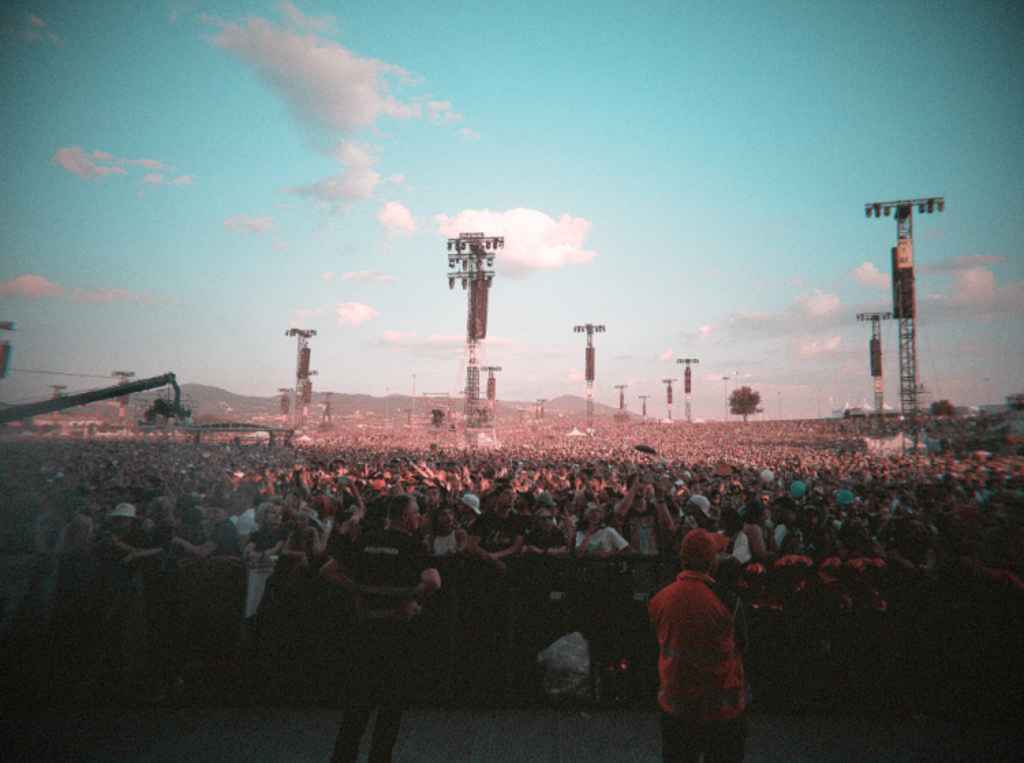
Agorà deployed three generations of L-Acoustics line source technology for Ultimo’s La Favola per Sempre concert at Tor Vergata in Rome, delivering coverage to an audience of 250,000 across a site extending almost 580 metres from the stage.
The concert was billed as the largest ticketed concert ever staged in Italy and presented a significant sound reinforcement challenge. The temporary site had no permanent event infrastructure, while the Policlinico Tor Vergata teaching hospital sits directly behind the stage, placing strict requirements on rearward noise.
FOH engineer Andrea Corsellini initially appointed L-Acoustics Certified Provider Agorà to produce a coverage study of the site before bringing the company on to deliver the
complete system.

Agorà specified the recently launched L1 with CS1 subwoofers for the main system, with K1 and K2 used across the nearer delay positions and V-DOSC deployed towards the rear of the audience area.
The system had to provide consistent coverage and low-frequency impact throughout the site while meeting noise limits behind the stage and at the event boundary.
Agorà FOH assistant Remo Scafati said: “The L1 main system was a game
changer, extremely powerful and good sounding. With its cardioid pattern, coupled with the CS1 subs, it helped us a lot with the challenge of noise control.”
L1 and CS1 incorporate cardioid low-frequency designs, with L-Acoustics quoting up to 26dB of rejection onstage and cardioid, supercardioid and side-rejection operating presets.
Agorà modelled the system in L-Acoustics Soundvision, using the software to predict coverage and spill across the site before equipment was rigged.
The delay
design was led by Antonio Paoluzi, who also developed software to recalculate delay times in response to changes in temperature and humidity.
“Soundvision is now a very precise tool for predicting coverage and delay times, and it was particularly useful in anticipating coverage challenges across the different areas of the site,” said Paoluzi.
The main system comprised four L1 hangs, with two main arrays and two side arrays. Each main hang incorporated two
CS1, five L1 and one L1D enclosure, while the side hangs used four CS1, three L1 and one L1D.
Eight additional CS1 units were flown centrally, while 63 KS28 subwoofers were ground-stacked in groups of three across the front of the site.
Kara II and A15 loudspeakers provided front-fill coverage, with an additional K1 hang extending coverage to one side. A separate system of 14 L1 enclosures covered a large VIP grandstand on
stage right. LA7.16 amplified controllers powered the L1 system.
Nine delay positions carried coverage towards the back of the site. K1 and K2 systems served the nearer positions before transitioning to K2 and then V-DOSC at approximately 460 and 520 metres from the stage. The final delay line, around 580 metres away, used K1. KS28 subwoofers reinforced the low end at each delay position, with Kara II serving the grandstand.
The system operated
over Milan-AVB using a star-topology Luminex network comprising a central hub and ten primary and ten secondary nodes.
Each delay tower incorporated an L-Acoustics LA-RAK II AVB and LS10 switch. An Optocore network supplied AES signals to the amplified controllers as an automatic fallback, while Agorà added an analogue feed as a third redundancy layer.
“The biggest operational challenge was the delay system,” said Valerio Motta, technical manager at Agorà. “Given the enormous
size of the venue, the intense working schedule and the extreme heat, getting everything into place and properly optimised was far from easy, but the final result made all the effort worthwhile.”
Luca Nobilini handled the main system, with Paoluzi responsible for the delay chain. L-Acoustics regional application engineer for EMEA South Tom Laveuf also supported the team during deployment, tuning and the concert.
Corsellini said: “It is one of the best-sounding systems
I have heard in my life, and the two system engineers, Luca Nobilini on the main system and Antonio Paoluzi on the delays, achieved an outstanding result. What we achieved for this historic concert is only possible through great teamwork and remarkable technical know-how.”
Agorà is also working with promoter Vivo Concerti and the University of Rome Tor Vergata on a research programme examining sound propagation and acoustic impact around events of this scale.